Click here to search our online archive for documents and images associated with this building.
 Family History
The Hottenstein family is descended from German nobility. The family traces its origins to Riebold von Hottenstein near Asschaffenburg, Germany in 380 A.D. Jacob Hottenstein was born on February 18, 1697 in Esslingen, Germany. Jacob Hottenstein was the original owner of the property and was a German immigrant who settled in Oley Township in 1727. Later, he would move into Maxatawny Township. He was married to a Maria Dorothea Reber and was buried in the family cemetery on the property when he died in 1753. They were members of the local Reformed congregation. The children of Jacob and Maria were Jacob, Dorothea, Maria Catherine, William, David, and Henry.
Jacob Hottenstein’s 1753 will stated, in addition to sons David and Henry inheriting the land, that David received a stallion and that his widow, Maria, would be allowed to remain on the property in either of two stove rooms (this is a hint at the earlier structure at this property). The will also left the following yearly bequest to Maria unless she remarried: 20 bushels of wheat, 100 weight of pork, 50 weight of beef, 2 Pounds in money, 20 pounds weight of clean flax, as much firewood as necessary, 1 hogshead of cider, the grazing of a cow, and the pacing of a mare.
Henry Hottenstein was working as a physician in Lancaster County at the time of his father’s death. David Hottenstein was born in 1734 and lived until 1802. David married a Sarah Herbein and their children were Jacob, David, Daniel, Catherine, and Dorothea. David and Sarah’s son David is the one that built the house.
David Hottenstein (the second) and his wife, Catherine, had six children. David and Catherine’s son David was the first in a long line of doctors in the family. Dr. David Hottenstein attended the Medical Institute in Philadelphia, practiced medicine in Berks County, was married to an Elizabeth Kline, and died at age 82 in 1848. David and Elizabeth’s children were David, Jacob, Daniel, William, Isaac, Henry, Catherine, and Sarah. This David was a brigadier general during the War of 1812.
A number of the Hottensteins were instrumental in founding what eventually became Kutztown University. Many of them even sat on the Board of Trustees over the years. Many are known to have studied medicine and dentistry at Ursinus College. It is believed that one Edward Hottenstein operated his dentistry practice out of the adjacent doctor’s office on the property.
The last Dr. David Hottenstein to live in the home had been a captain in the U.S. Navy until he retired in 1969. At one point, David was the head of the naval hospital at Aberdeen, Maryland. He generously entrusted his magnificent family homestead to the Historic Preservation Trust in 1976.
Architectural History
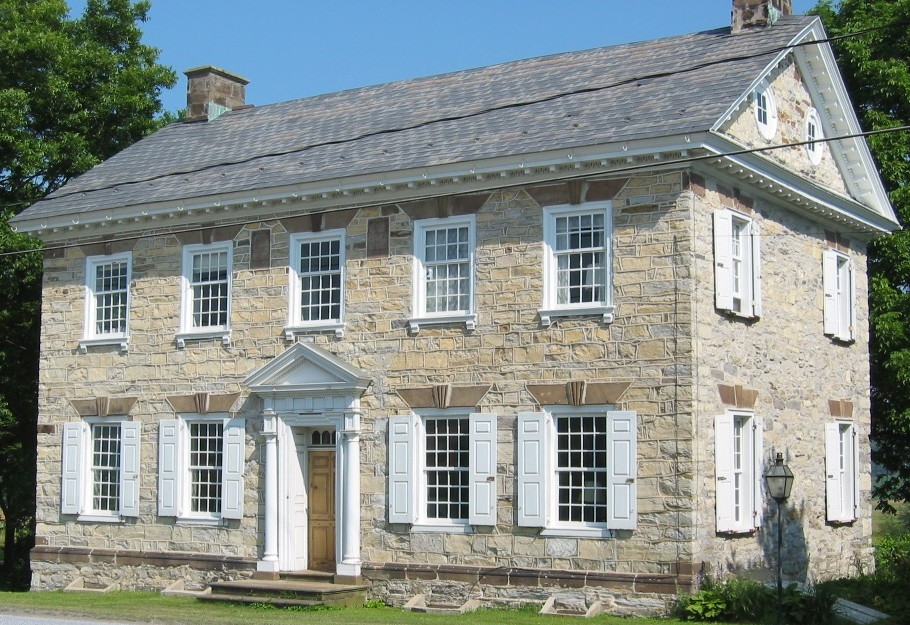
The main house was built in 1783 by David and Catherine Hottenstein; it is an outstanding example of German style detailing added to a traditional Georgian floor plan. The two and a half story building is made of limestone with dressed stone on the principal façade and rubble stone on the other three walls. The cornice and eaves of the original block consist of crown mold, fascia, modillioned soffit with Greek key mold between modillions, and bed mold. Each soffit corner has carved sunflowers between modillions. There is a belt course and a plinth shelf carved from native sandstone, even though the majority of the structure is made from limestone. Also, there are sandstone lintels with a raised key stone over each window. The unique date stones are also made from carved sandstone. All the exterior openings in the structure are original and unaltered. A number of shutters which appear to be original to the structure are currently stored in the attic of the summer kitchen.
The house is completely unique to the area for its style, workmanship, and detail. The remaining interior features original mantles and paneling, corner cupboards, and hand-wrought hardware. The central hall of the interior is elaborately decorated with pilasters, pediments, fluting, and crown molding among other things. Most of the remaining original woodwork is intact with some original paint including stippling and graining. The door between the current kitchen and the dining room is not original (the frame of this opening dates from between 1840-1860). The original stair to the basement would have been a winding stair. The wood work and detailing from the current kitchen has been completely gutted—some of this work was moved to the large second floor bedroom. All of the interior locks are Germanic. Most of the doors in the house are supported by rat-tail pintles. The attic door is hung on “ram’s horn” hinges. These types of features give this Georgian home a Germanic overtone. The asymmetry of the paneling may suggest unfamiliarity with the Georgian aesthetic. The three-room plan on both floors can be interpreted as either a Germanic survival plus central hall plan, or an adaptation of a central hall English Georgian plan.
The rear kitchen ell was added around 1847 and supposedly is made from stones from a church that once stood near Bowers Road. The windows and trim of this wing are of the Federal style. There is also a summer kitchen which was attached to the main house by a shed-roofed porch around 1965. The interior of the loft in the summer kitchen is blackened, as though it was used for smoking. In the mid-nineteenth century Greek revival front porch was added. The Historic Preservation Trust of Berks County has replaced it with a classical revival pedimented replica based on evidence in the adjacent masonry. The last David Hottenstein to live in the home installed the modern kitchen.
The interior of the largest bedroom was removed in 1950 and is currently known as the Fractur Room at Winterthur Museum in Delaware.
Outbuildings include a smokehouse, bake house, root cellar, and a two-car garage with a workroom and greenhouse attached. There is a separate building which housed a doctor’s office. Across the street in a farm field is located the Hottenstein family cemetery
Property History
The original farm that Jacob Hottenstein owned covered 116 acres. Jacob had settled in what would eventually become Maxatawny Township in 1729 after living in Oley Township for a couple of years. After leasing his 116 acres for one year from Caspar Wistar, Jacob bought the land on November 18, 1729 for 40 Pounds. Jacob acquired 50 more acres in 1742, another 176 acres in 1751 and eventually even more to total an additional 327 acres to his land holdings. Prior to 1734, Jacob was paying a quit rent for his land. David Hottenstein inherited half the land from his father Jacob. David acquired the other half of the land by buying out his brother’s (Henry’s) share of the inheritance. On the 1759 tax list, David Hottenstein is listed as paying 23 Pounds.
The 1854 Berks County Atlas lists a W. Hottenstein as residing in the house and the 1862 Berks County Atlas lists a David Hottenstein, Esq. In 1876, an H. S. Hottenstein was listed as a resident.
The Hottenstein Mansion was placed on the National Register of Historic Places on June 22, 1972. The property remained in the Hottenstein family though until 1976 when the Historic Preservation Trust of Berks County received it as a gift from Dr. David Fulmer Hottenstein. David Fulmer Hottenstein was the last member of the family to live in the home.
The Hottenstein House is located along Rt. 222 in Kutztown and is tenanted. If you are interested in touring this property, please contact the Trust office. The Historic Preservation Trust does not guarantee the availability of a tour of this property. Please respect the privacy of the tenant by not trespassing on the property.
Interested in learning more about the Hottenstein House and the Historic Preservation Trust of Berks County? Search records, pictures, images, architectural drawings and more in our Online Archive.